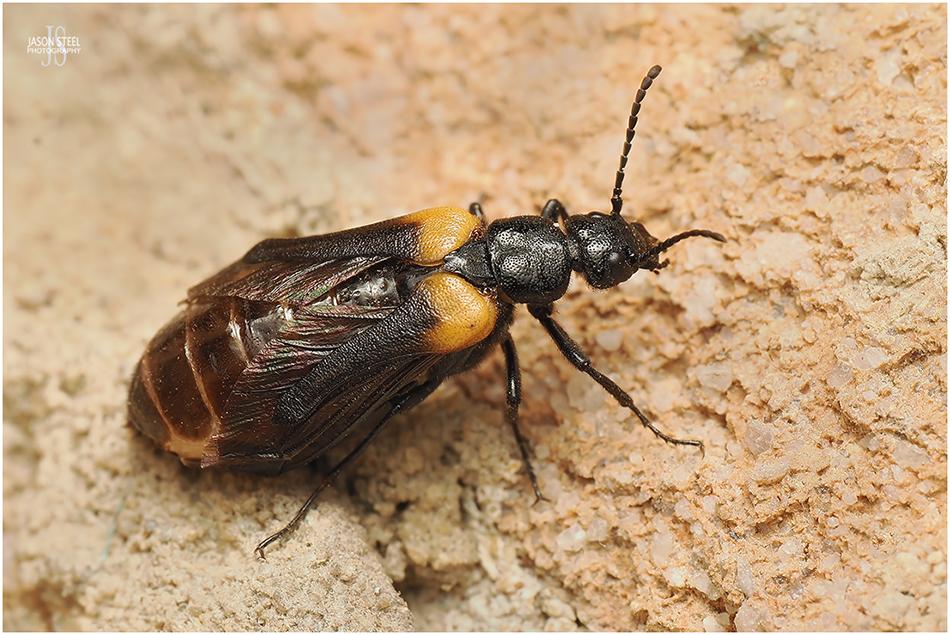
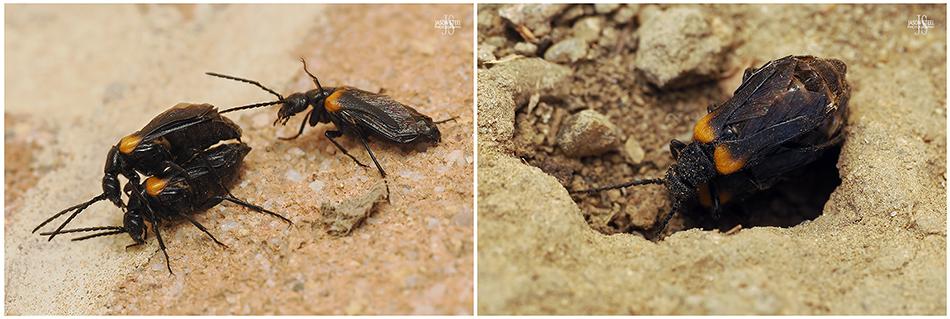
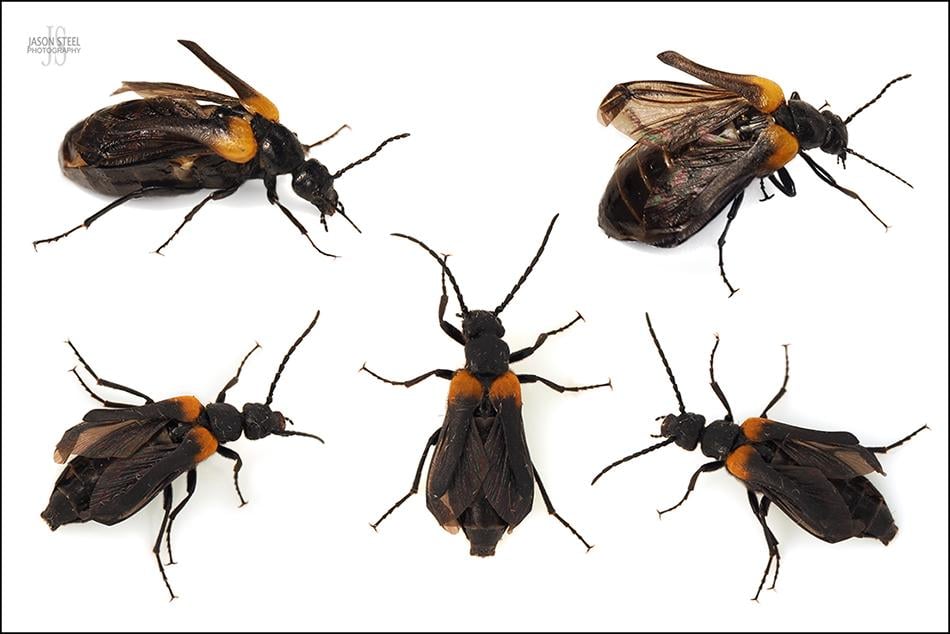
Top: 14mm female Orange-shouldered Blister Beetle. Bottom left: Mating Beetles. Bottom right: Female checking out a bee burrow. 6th August 2026.
Orange-shouldered Blister Beetle / Flame-shouldered Blister Beetle - (Sitaris muralis)
The Orange-shouldered Blister Beetle is an interesting species from the family Meloidae, which contains the Blister Beetles and Oil Beetles. Beetles from this family are known for their defensive secretion of a blistering agent, cantharidin, which causes human skin to burn and blister on contact. The Orange-shouldered Blister Beetle announces its toxicity to would be predators with its aposematic colouration. These dark black beetles have bright orange coloured patches at the top of their elytra. Despite having fully developed hind wings the Orange-shouldered Blister Beetle is very rarely, if ever, observed to fly. Some sources claim that Sitaris muralis is not capable of flight at all, whilst other sources claim that these beetles are capable of clumsy flight, but nearly always get around by walking instead. In a recent scientific paper, published in 2017, Paul D. Brock, from the prestigious Natural History Museum in London, clarified the matter with the following comments: "While flight is virtually non-existent, or functionally absent in daily movement, extremely rare observations of males briefly taking off, or fluttering short distances to find mates, have been noted, but they are fundamentally ground- and wall-dwelling walkers."
Adult specimens typically grow to a body-length of around 8-14mm, with most specimens measuring 10-11mm. The females are larger than the males and have clearly distended abdomens. Males have slightly longer antennae than the females. Both sexes have strangely twisted elytra, which do not completely cover the folded hind wings, partially hidden beneath.
Like the Oil Beetles the Orange-shouldered Blister Beetle is kleptoparasitic within the nests of Digger Bees. Sitaris muralis is strongly associated with the Hairy-footed Flower-Bee, Anthophora plumipes, which typically builds its nest in old stone walls. Sitaris muralis has also been associated with the rare Potter Flower Bee, Anthophora retusa, too. In late summer the female Orange-shouldered Blister Beetle lays her eggs on the ground, near the burrows of the bees. Once the eggs hatch the larvae overwinter and become active the following spring. The larvae have three distinct stages, and forms. In the first form they are known as triungulins. The second forms are known as apodous eruciform larvae. The final form is the prepupae stage.
In the spring some of the newly emerged beetle larvae climb up the stems of flowers and await the visiting bees. When the bees visit the flowers, to collect pollen and nectar, the beetle larvae attach themselves to the bees and hitch a lift back to the burrows of the bees. Other beetle larvae, which hatch from eggs laid around the entrance to the bee's burrows, may wander into the burrow themselves, or may be accidentally carried into the burrows by unsuspecting bees. Once in the burrows the beetle larvae search for the eggs of the bees, which they then feed upon. Triungulins that emerge near the entrance to male bees would need to transfer to the burrows of female bees. This is most likely done by hitching a ride upon male bees and transferring over to the female bees during the mating of the bees.
Once the bee's eggs have all been consumed the triungulin beetle larvae transform into their later stage of development, as apodous eruciform larvae. The beetle larvae now turn their attention to the bee's honey, which the bee had stored for the development of its own larvae, had its eggs survived. The beetle larvae continue feeding upon the honey until the end of the year, before transforming once again into their prepupae stage, which hibernate within the bee's burrow. The beetle larvae then pupate the following spring, before emerging in the late summer, of their second year, as adult beetles. It's not clear exactly what triggers the adult beetles to emerge but they often do so in mass. These adult beetles can be found, occasionally in high numbers, on south-facing brick, or stone walls. The Adult beetles are short-lived and their primary focus is on mating and reproducing. Where the beetles are found they are sometimes seen in mating balls, consisting of several specimens of both sexes. From my own observations, where the adults emerge in high concentrations, both the males and the females mate repeatedly, with many different mating partners. The males may live for several days after mating, but become very lethargic once mating has taken place. Once mated the females are quick to lay their eggs. Once the eggs are laid the females die very shortly after.
Sitaris muralis is described as an Eastern Palaearctic species, which is at the far NW edge of its range in England, Sitaris muralis is a rare species, especially in Britain, where it is classed as vulnerable. Records of this species in Britain have been very scarce until recent years, but they are still far from common. Most British records of this species come from the south, and south-east of England, particularly in suburban areas around the New Forest, in Hampshire, and from Dorset and Wiltshire. The Orange-shouldered Blister Beetle was once feared of being extinct in the UK. This species was found in Oxfordshire up until 1969 before disappearing completely. The Orange-shouldered Blister Beetle wasn't seen again in the UK for the next 41 years, until it turned up in Brockenhurst, in Hampshire in 2010. Before the 2010 sighting the beetle hadn't been seen in the New Forest area for over 100 years. In recent years this rare beetle seems to be making a significant comeback since 2015, and there are now dozens of new records of sightings, from southern England. It's not clear why the Orange-shouldered Blister Beetle is so rare in the UK, when its primary host, the Hairy-footed Flower-Bee, is common and widespread.
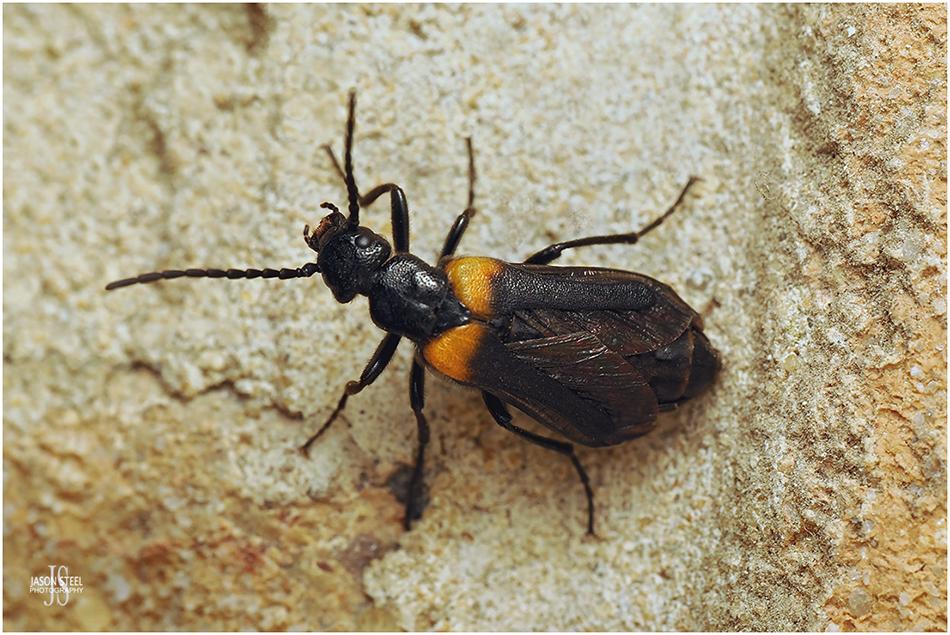
10mm male Orange-shouldered Blister Beetle, on a residential wall in Erith, SE London. 6th August 2026.
On the 6th August 2026 I was contacted by a good friend of mine, Trevor Slatter, who had noticed large numbers, of what he believed to be Orange-shouldered Blister Beetles, climbing on the external wall of his residential block of flats, in Erith, SE London. I immediately went to investigate and found the beetles climbing all over the wall, on the bare soil beneath the wall, and upon the footpath. In total I counted 89 Orange-shouldered Blister Beetles, which were an even mixture of both male and female specimens. The patch of bare soil beneath the wall had long been home to large numbers of Digger Bees, which hadn't been identified to species level. These resilient bees had survived here for several years, despite some of the local residents trying to kill them off on occasion by pouring boiling water down their burrows. Despite these bees making this patch of soil their home for several years the Orange-shouldered Blister Beetle had never been seen in the area until this mass emergence in 2026.
* I'd like to grateful thanks to Trevor for alerting me to the presence of these Blister Beetles in Erith. *
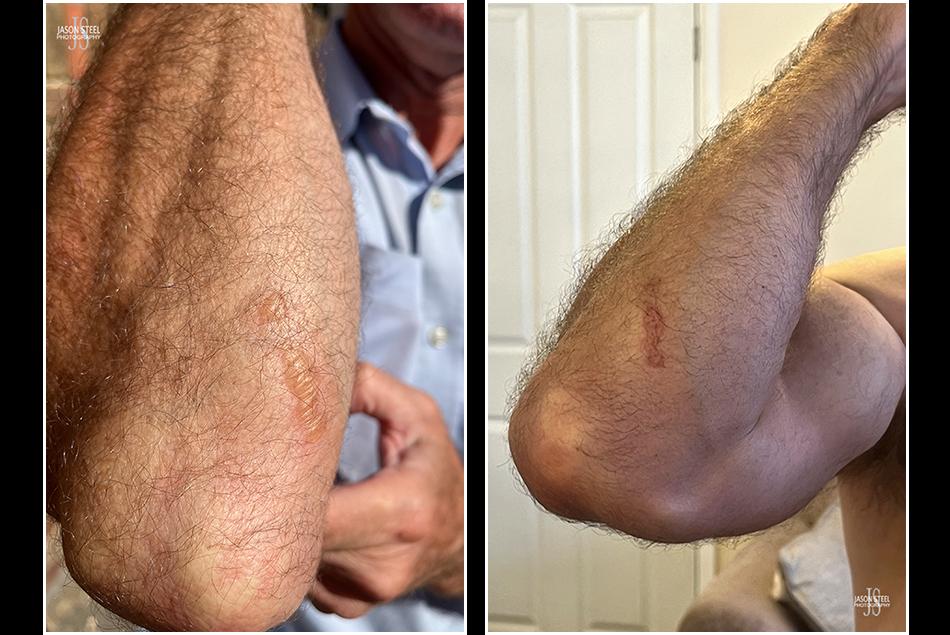
a) 7th August 2026, 1 day after burn from Blister Beetle. b) 9th August 2026, 3 days after burn from Blister Beetle.
The pavement that runs into the block of flats in Erith was littered with several dead Orange-shouldered Blister Beetles, which had been accidentally trodden on by residents of the flats. There were also numerous specimens which had been trapped in the webs of juvenile Noble False Widow spiders, Steatoda nobilis, which were situated near the top of the wall. Despite the toxicity of the beetles I observed two of the Steatoda nobilis feeding upon these beetles, which had become trapped in their webs. Some of the Orange-shouldered Blister Beetles I tried to photograph curled up and feigned death for several minutes, before continuing their march across the brick wall.
I captured a couple of the beetles to take home and photograph. This proved extremely difficult as the beetles were highly active and didn't stay still long enough for me to photograph. With the reputation these Meloidae beetles have for being highly irritant to human skin I was careful not to allow the beetles t touch my skin. Despite this approximately two hours after attempting to photograph the captive beetles I starting to feel a strong burning sensation on my forearm. I immediately had a bath, and thoroughly scrubbed my skin. I then generously applied Savlon antiseptic cream to the sore area and took an antihistamine pill. The burning sensation continued to increase on my forearm. The next day I awoke at 4am to find a line of blisters had started to form on my arm. Although I hadn't allowed the beetles to touch my skin at any time they had obviously left a trail of their defensive secretion on the white plastic sheet, upon which I was attempting to photograph them on. Obviously I hadn't noticed this secretion and had rested my arm in it when leaning on the sheet to stabilise my hands, to achieve steady shots of the beetles. At no time did I observe this secretion so it must have been produced in very small quantities. The cantharidin secretion must have been very potent to cause such blistering from such small quantities.
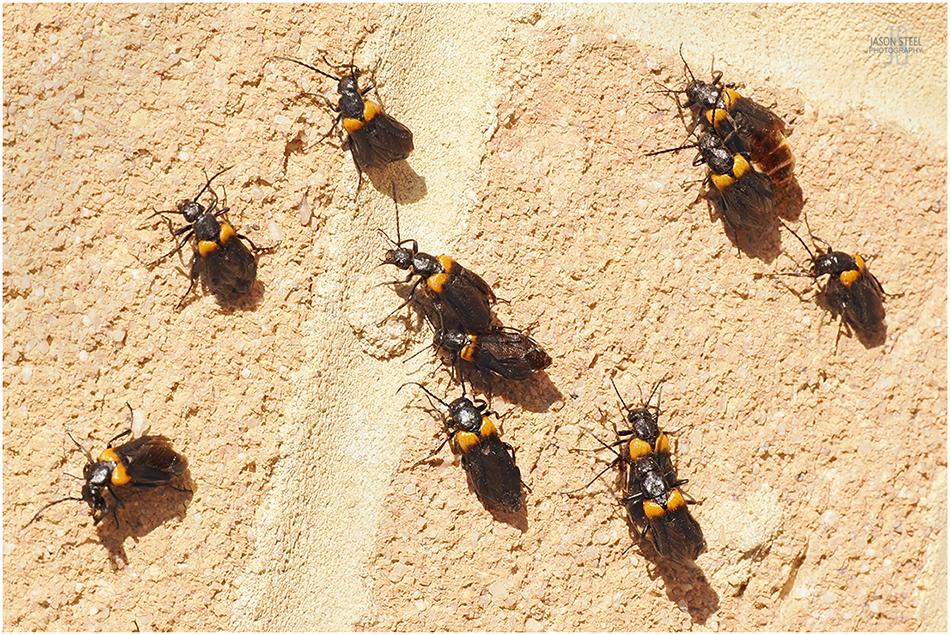
11 of the 89 Orange-shouldered Blister Beetles I counted on the residential wall in Erith, SE London. 6th August 2026.
The next day I returned to the block of flats in Erith to release the beetles. Upon my arrival I was pleased to discover that the majority of the beetles were still on the wall. They were less active than they had been on the previous day though. I counted over 60 specimens still on the wall. The female specimen that I had captured was released back onto the wall. The male specimen, which had been mating with the female in captivity for the last 24 hours, had now died. I decided to keep hold of the dead male specimen and take it home for a second attempt at photographing it. It's definitely a great deal easier to photograph a dead beetle than a highly active live specimen. At the bottom of the pot, which had temporarily housed the two captive beetles, I discovered many hundreds of tiny pale eggs had been deposited. I deposited these eggs on the ground, near the burrows of the bees, as the female beetle would have done herself had I not captured her. I observed several adult female beetles wandering around the edge of, and wandering just inside, the openings of the bee burrows. They may have been depositing their eggs, or just checking for the presence of the host bees before deciding where to deposit their eggs.
On the 8th August, 2 days after the emergence of the Blister Beetles in Erith, around 60 specimens still remained on the wall, approximately the same number as the previous day. 2026 seems like a very good year for this species in England. On the 10th of August I paid another visit to the Erith site. Approximately 30 specimens remained on the wall. All the remaining specimens were male. Several of the males on the wall were dead, but most were very lethargic and clearly dying. There were also quite a few dead specimens beneath the wall too. Not a single female specimen remained on the wall. After several days of mating the females had all left to deposit their eggs. On the 13th August 2026, 8 days after the beetles emerged, around 20 male specimens still remained on the wall, but all were now dead.
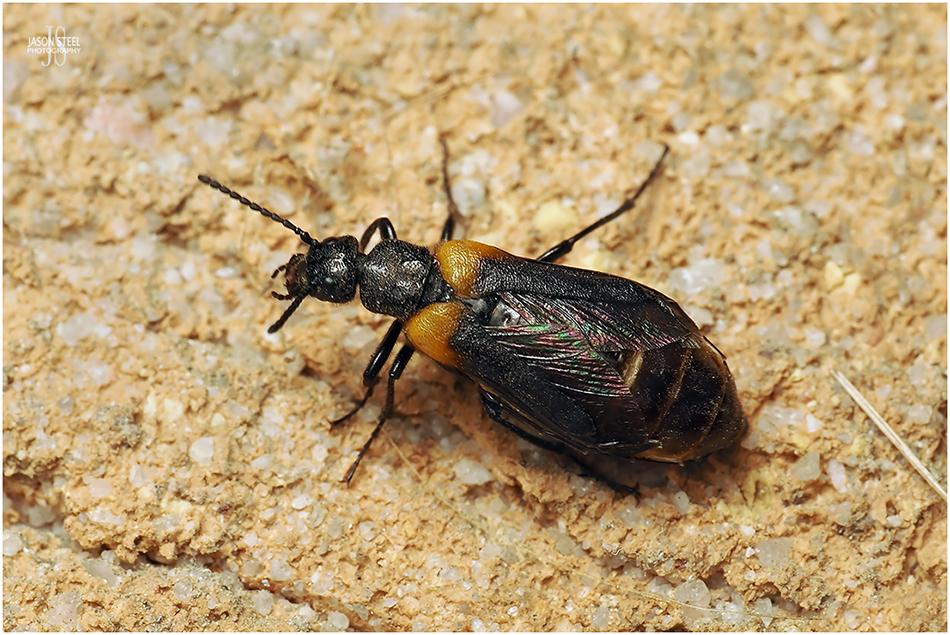
12mm female Orange-shouldered Blister Beetle, on a residential wall in Erith, SE London. 6th August 2026.
2025 had proved to be a very good year for the Orange-shouldered Blister Beetle, with quite a few sightings being recorded. 2026 also proved to be another good year for this species. During the week when I observed these Orange-shouldered Blister Beetles, there were also five separate records of sightings from other sites in England too. One record came from Chichester, in West Sussex - LINK. The second record came from Headington, in Oxfordshire - LINK. The third record came from Swindon, in Wiltshire - LINK. The fourth record came from Faversham, in Kent - LINK. The fifth record came from West Berkshire - LINK. Buglife also reported having received several records of sightings during August 2026 from members of the public.
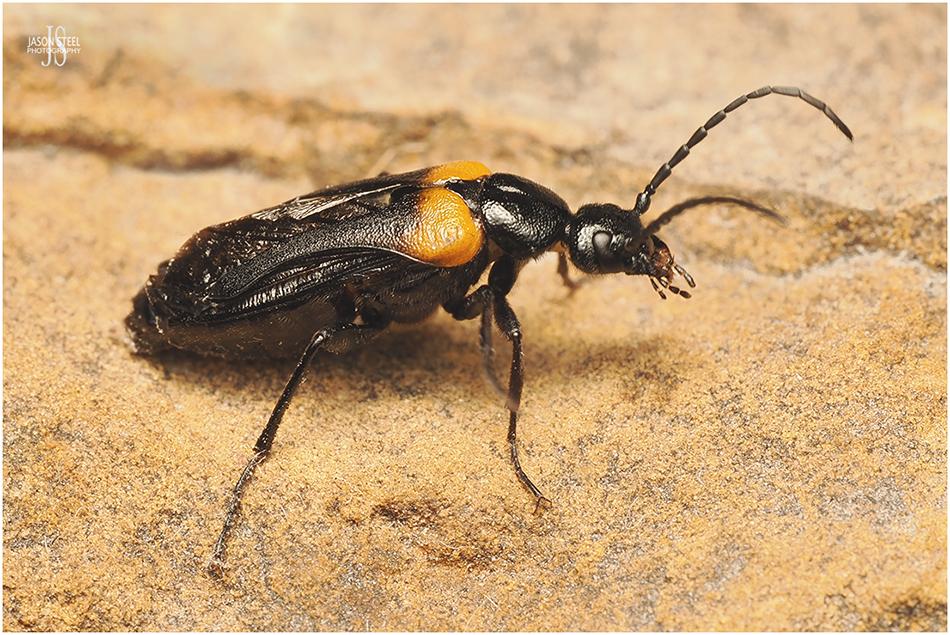
10mm male Orange-shouldered Blister Beetle, on a residential wall in Erith, SE London. 7th August 2026.
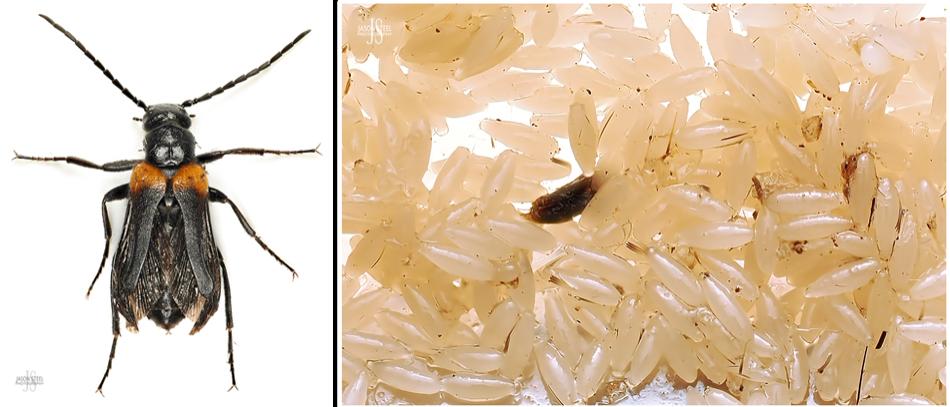
10mm male Orange-shouldered Blister Beetle, and eggs from the female.
Orange-shouldered Blister Beetles. Female top, Male below.