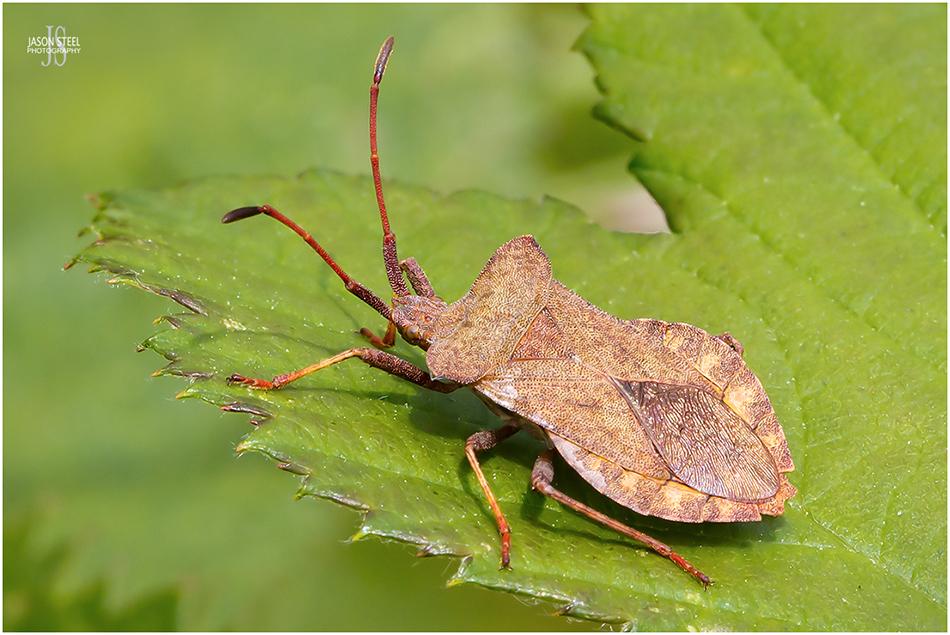
Dock Bug - Coreus marginatus. One of many found on brambles in a grass meadow, in Bexley, SE London. 21st June 2016
Dock Bug (Coreus marginatus)
The Dock Bug grows to around 13-15mm, and is common in central and southern UK. Until recently they were one of the easier bug species to identify in the UK, with their distinctive body-shape. In recent years the expansion of the range of the very similar Box Bug, Gonocerus acuteangulatus, has made identifying this species more difficult.
Dock Bugs are found in a variety of habitats, including hedgerows, woodland edges, fields and gardens. Adults emerge and mate in early spring. The next generation of adults can be seen around August. Nymphs can typically be seen from early summer. Both adults and nymphs are herbivorous and feed on Docks, Sorrels and other plants in the family Polygonaceae. They can also be found feeding on species of Asteraceae and Rosaceae too. Adults can sometimes be confused with the rarer Boat Bug, Enoplops scapha, which is a coastal species that tends to be greyer in colour.

Dock Bug, Coreus marginatus, at an ornamental garden in Bexley, 20th April 2023.

Dock Bug, Coreus marginatus, at Dartford Heath, Kent, 20th September 2024.
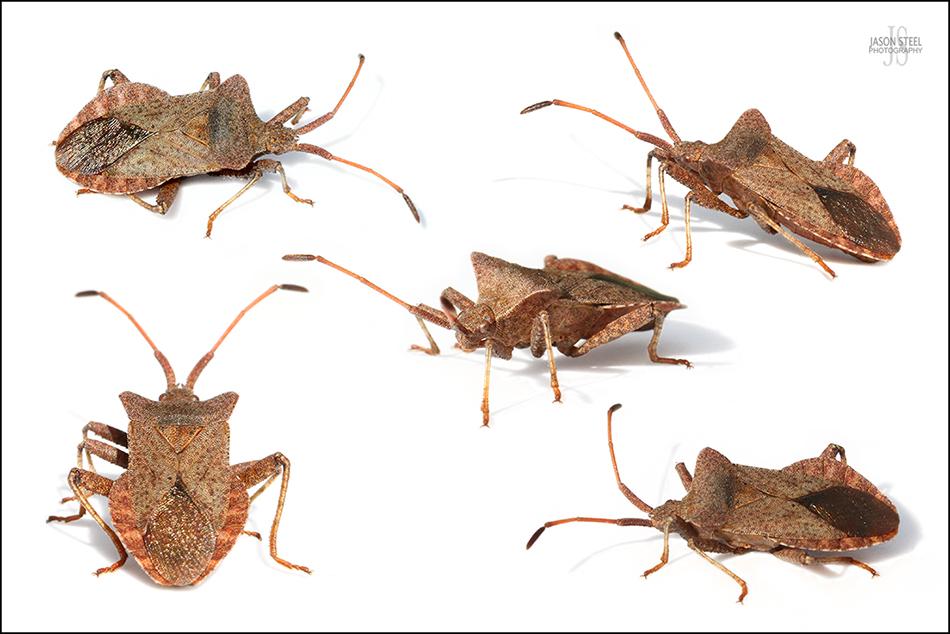
Dock Bug - Coreus marginatus. 16th April 2017

Late instar of the Dock Bug (Coreus marginatus)

An overwintered adult Box Bug, found on lakeside vegetation in Cliffe, Kent, 30th March 2024.
Box Bug - (Gonocerus acuteangulatus)
The Box Bug is a fairly large Heteropteran Squashbug, from the family Coreidae, that grows to an adult length of around 11-14mm. This species is common throughout the Mediterranean, parts of Asia, and parts of Europe. In the UK the Box Bug was originally confined to just one site, Box Hill in Surrey. There it was found feeding entirely on Box Trees. In the late 1990's the Box Bug began expanding its range and was discovered to have adapted and modified its diet to feed on various other food plants besides Box, especially Hawthorn and Buckthorn. Box Bugs have since been recorded feeding on Box, Buxus sempervirens, Hawthorn, Crataegus monogyna, Dog-rose, Rosa canina, Japanese Rose, Rosa rugosa, Wild Rose, Rosa spp., Yew, Taxus spp., Buckthorn, Rhamnus spp., Buckthorn, Frangula alnus and Domestic Apple, Malus domestica, Lawson’s Cypress, Chamaecyparis lawsoniana, Honeysuckle, Lonicera spp., Oak, Quercus spp., Alder, Alnus spp., Hazel, Corylus avellana, Juniper, Juniperus sp. and White Cedar, Thuja occidentalis.
By the early 2000's the Box Bug was well established throughout much of Surrey and was also turning up in the neighbouring counties too. By 2023 the Box Bug had been recorded from much of south-east England, the Midlands, East Anglia, as far north as Yorkshire, and as far south as Devon.
Adult Box Bugs can be found all year round. They typically feed on the juices of ripe fruits and seeds from the host shrubs, trees and plants. In Europe the Box Bug is considered a pest to both Hazel and Pistachio.
Adult Box Bugs are reddish-brown in colour but the nymphs, although they have a similar shape to the adults, their abdomen is often bright green, which can become dull orange-red towards the end of the season. LINK. The Box Bug goes through five instars before reaching maturity. Mating is usually observed in June and July. The eggs are laid in batches of up to 15 eggs, and are fixed to leaves or branches of the host plants. The nymphs are typically found from July to September. New adult Bugs appear from August onwards and overwinter, usually in evergreen trees and bushes such as Holly, Ivy and Pine.
The Box Bug, Gonocerus acuteangulatus, is very similar to our native Dock Bug, Coreus marginatus, and the two species are easily confused. There are key features to help distinguish between the two. The Dock Bug is far broader, and has wider, more rounded abdomen with a larger "skirt", and more rounded shoulders. A close inspection of the head makes separating them much more certain. On the "nose" of the Dock Bug there are two small projections. On the "nose of the Box Bug there is just one single projection. See image below. There is also a comparison photo here: LINK

Comparison photo of the heads of the Dock Bug, Coreus marginatus, and the Box Bug, Gonocerus acuteangulatus.

One of several 6mm Lygus cf pratensis found on Common Ragwort plants growing at the edge of a grass meadow in a valley on the North Downs in Kent. 23rd July 2023.
Tarnished Plant Bug - Lygus pratensis
The Tarnished Plant Bug is one of five Lygus species in the UK that are extremely difficult to identify without very close examination under high magnification. Lygus pratensis was once confined to heathland sites in the south of England. This species has rapidly expanded its range in recent years and is now common and widespread in much of southern Britain. Tarnished Plant Bug grows to around 6-7mm in length and adults can be found all year round. In the USA, where it feeds on a wide variety of trees, grasses and cereal crops, the Tarnished Plant Bug is considered a pest species. Early instars are green in colour and do not usually take on the darker colouration until the final instar. Worldwide there are over 40 species in the Lygus genus.